
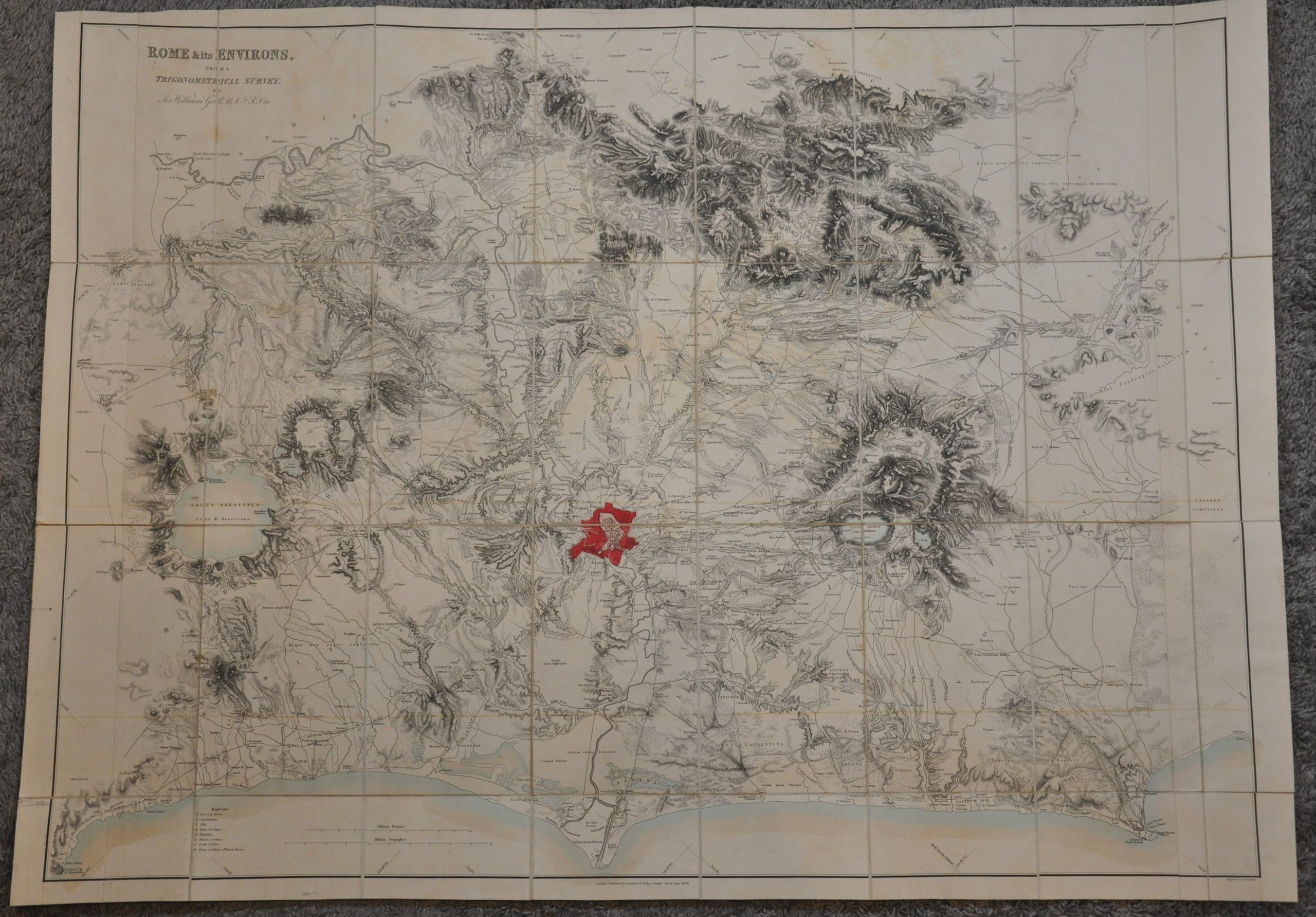
Rome & its Environs, from a Trigonometrical Survey
$ 98.85
Categories: Lyhythihaiset Kauluspaidat, Turntable Cartridges & Accessories, Brand: Armaf
This marvelously detailed map of the area around Rome was engraved by J. Gardner and published in London by Sanders & Otler in 1834. The design was conceived by Sir William Gell, a British archaeologist and Fellow of the Royal Society. He specialized in classical topography and was notable for his works on the landscape around Troy, Pompeii, and several sites in Greece. The image, oriented with east at the top, attempts to replicate the world of the Roman Empire, including its legendary network of roads. Dozens of toponyms pinpoint the locations of various ruins, temples, villas, and more, generally using Classical naming conventions. A legend in the lower left offers further information on the different labels used. Topography is shown with delicately engraved hachures, emphasizing the Apennines and Alban Hills. The map is analyzed in an interesting article by the University of Colorado, an excerpt of which is below; “On this broad canvas, highlights of the natural environment, as recorded by Gell’s trigonometrical survey in 1822 (I: vi), appear alongside features of the artificial environment, as they existed in Classical times. Both dimensions are elaborated in meticulous detail: the former includes mountains, hills, lakes, ditches, streams, rivers, canals, and parts of the coast; while the latter numbers cities, villages, villas, towers, tombs, roads, ruins, and bridges… For Gell, the most important function of “Rome and its Environs” was pedagogical—it provided, he believed, a topography so detailed that “a student reading the account of any battle may be certain that here stood such a height & there ran such a brook” (Gell in Italy, 59). Reviewers added other roles. In the pages of the Athenaeum, for example, it was described as likely to “find a place in every good library by the side of Gibbon’s History,” and as “absolutely indispensable” for the “classical scholar and student” [Anonymous 557]. In these contexts, “Rome and its Environs” functions variously as orientation device, archive of information, and device for imagining the environment in which historical events took place. These features enable it also to function as a guidebook (although admittedly rather unwieldy) for actual travel to Rome and as a vehicle (whether the viewer is in England or Italy) for virtual travel to the Classical Age.” Source.